October 21, 2026
How AI Can Help Businesses Identify New Global Market Opportunities
read more


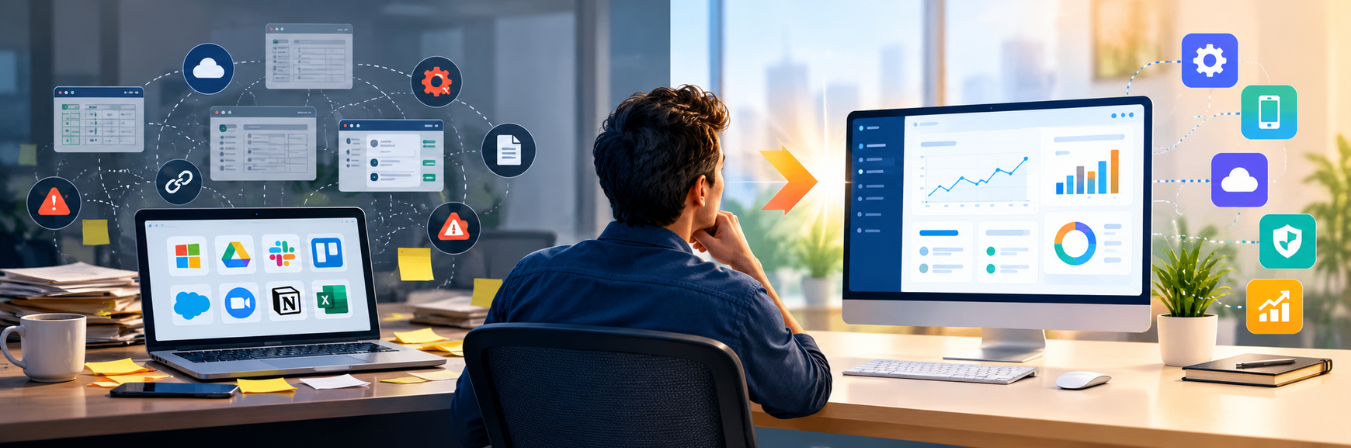
Most businesses start on off-the-shelf tools, and honestly, that makes sense. They're cheap, quick to set up, and good enough to get moving without overthinking it. But there's usually a point, a year in, maybe three, where the same tools that once felt like a shortcut start feeling like a wall. Workarounds pile up. Someone builds a spreadsheet to patch a gap the software was never meant to cover. Growth starts bending around what the system allows instead of the other way round.
That's usually the moment custom software development stops sounding like a luxury and starts sounding like plain common sense.
Generic software is built for the average business, which really means it's built for nobody in particular. It covers the basics fine, but the second a business has a process, a workflow, or a customer experience that doesn't quite fit the mould, things get messy fast. Teams end up bending how they work to suit the software, rather than the software bending to suit them.
That trade-off is fine for a while. It stops being fine once the inefficiency starts showing up in the numbers: slower processes, duplicated work, tools that don't talk to each other, and a growing pile of manual fixes nobody actually has time to maintain properly.
A few signs tend to show up before anyone realises the business has outgrown its current setup. Staff are spending real hours working around the software's limits instead of the software actually saving them time. Several tools are quietly doing overlapping jobs because no single system covers what the business needs anymore. Data lives scattered across different places and never quite lines up when someone needs to pull it together. And every feature request to the vendor gets the same reply: that's just not something we support.
None of that feels dramatic on its own. Stacked together, though, it quietly puts a ceiling on how fast a business can actually grow.
This is where custom software solutions earn their reputation. Instead of a business twisting itself to fit a generic product, the software gets built around how the business genuinely works, its processes, its data, its customers, its own idea of what "efficient" even looks like.
A custom system doesn't carry a dozen unused features nobody asked for, and it doesn't skip the one feature a business actually depends on. It's shaped around real operational needs from the start, which usually means fewer workarounds, less duplicated effort, and a system that supports how a team already works instead of quietly fighting them at every turn.
Off-the-shelf tools tend to hit a ceiling somewhere, a user limit, a feature cap, a pricing tier that stops making sense the moment the business grows past a certain size. Custom software for business gets built with that growth already in mind, so scaling up doesn't mean migrating to a new platform every couple of years and dragging the whole team through onboarding again.
One of the quieter costs of generic software is how badly different tools talk to each other, or don't. Custom development can be built to plug directly into the systems a business already relies on, cutting out the manual exports, imports, and duplicate data entry that eat up hours nobody's really tracking.
| Factor | Off-the-shelf software | Custom software development |
|---|---|---|
| Setup time | Fast, ready almost immediately | Longer upfront, built around real requirements |
| Initial cost | Lower to start | Higher initial investment |
| Fit to business processes | Business adapts to the tool | Tool adapts to the business |
| Scalability | Often capped by vendor limits | Built to grow alongside the business |
| Long-term cost | Recurring fees, plus the cost of workarounds | Higher upfront, generally lower over time |
| Ownership | Rented, tied to a vendor's roadmap | Owned outright, roadmap set by the business |
Neither side wins universally. A small business testing an idea rarely needs a custom build on day one; that would honestly be overkill. But a business that's already scaling, or one whose processes have genuinely outgrown generic tools, tends to hit a point where software-development quietly flips from the expensive option to the cheaper one over time.
The starting point is never the code, whatever it might look like from the outside. It's understanding what's actually slowing a business down, where the manual work is piling up, where the existing tools are quietly costing time nobody's noticing, and what the business will genuinely need the software to do three years from now, not just this quarter.
From there, the build itself gets shaped around real workflows rather than guesses about what a typical business might want. That difference shows up later, in how little a team has to fight the system just to get their work done, and in how easily the software keeps pace as the business changes shape around it.
Custom software isn't really about having something flashier than a competitor's off-the-shelf setup. It's about removing the quiet friction generic tools eventually introduce: the workarounds, the mismatched processes, the growth that keeps bumping up against a system's limits. Businesses that invest in the right custom software solutions early tend to spend a lot less time later untangling problems that never needed to exist in the first place.
If a team spends more time working around its software than working with it, that's usually the clearest sign it's time to talk about building something that actually fits.
Customizing off-the-shelf software means tweaking someone else's product. Custom software development means building the thing around your actual workflow from scratch.
Not really. It's more about whether your processes have outgrown generic tools; small businesses hit that point too, just sometimes sooner than expected.
Depends on scope, but expect a few months for anything meaningful. Rushing it usually means rebuilding parts of it later anyway.
That's kind of the point of going custom; it's built to evolve with you, not locked into a vendor's fixed feature set.
Yes, that's actually one of the bigger advantages. It can be built to integrate directly instead of forcing manual workarounds between systems.

 August 10, 2026
 August 3, 2026

 July 15, 2026
 July 6, 2026
.png)